Ranking on Google but Getting the Wrong Leads? Your Keywords Could Be the Problem

Imagine spending six months trying to rank on Google. You finally reach page one. Organic traffic climbs. Your SEO dashboard looks fantastic. And then the enquiries start arriving. Except they're not the enquiries you wanted.
People are asking for services you don't provide. They're looking for the cheapest possible option.
They're outside your service area. They're students looking for information. r they're reading your content but never contacting you at all. This is one of the less obvious ways SEO can go wrong.
You can rank successfully for the wrong audience.
For example, a Canberra consultant, accountant, builder, allied health clinic, lawyer or other service business, that distinction would matter. Because the goal of SEO isn't simply to attract people. It's to attract enough of the right people. And that starts with understanding search intent.

The keyword that ranks #1 might not be your best keyword
SEO tools naturally draw our attention towards numbers.
Search volume: 2,900
Keyword difficulty: 31
Current position: 8
Potential traffic: high
It's tempting to look at those numbers and conclude:
“That's the keyword we need.”
But there's another question that matters much more i.e. Why is someone searching for it?
Suppose you operate a bookkeeping business. You discover two keywords: “bookkeeping” and “small business bookkeeper Canberra”. The first may have considerably more search volume. But someone searching bookkeeping could be looking for: a definition, a course, a job, software, a template, DIY instructions, or a professional service.
Someone searching small business bookkeeper Canberra has revealed much more about what they want. Lower volume doesn't necessarily mean lower value. In fact, for a local service business, the opposite can often be true.
What search intent actually means
Search intent simply means: What is the person trying to accomplish with this search?
Google isn't only trying to match words. It's trying to understand what type of result is most useful for the person performing the search. Try searching different phrases yourself and look at the results.
For one query, Google may predominantly display guides and articles. For another, you may see service pages and local businesses. Another may return product pages. Those results give you clues about what Google believes the searcher wants. That's why keyword research shouldn't stop at putting phrases into a spreadsheet. You need to look at the intent behind them.
The four types of search intent
SEO professionals often group searches into four broad categories:
Informational
The person wants to learn something.
Examples:
“What does a conveyancer do?”
“How often should air conditioning be serviced?”
“What causes lower back pain?”
These searches can be excellent opportunities for educational content. But the person may not be ready to purchase anything yet.
Navigational
The person is trying to find a specific website or business.
For example: “Xero login” or a search for a specific accounting firm.
They're already looking for a particular destination.
Commercial investigation
Now the person is evaluating options.
Examples might include:
“best CRM for small business”
“accountant vs bookkeeper”
“best physio for runners Canberra”
These searchers are often much closer to making a decision.
Transactional
The person wants to take action. For a service business, that might look like:
“emergency plumber Canberra”
“book tax accountant Canberra”
“building inspection quote”
The search volume may be smaller. But the commercial intent can be considerably stronger. This is why evaluating SEO purely through traffic can be misleading.
Why high search volume can send your SEO strategy in the wrong direction
Imagine you're an employment lawyer. An SEO tool shows: “unfair dismissal” — 8,000 searches and “unfair dismissal lawyer Canberra” — 250 searches. Which keyword is more valuable?
At first glance, 8,000 searches looks far more attractive. But think about the people behind those searches.
Someone searching unfair dismissal could be: an employee, an employer, a university student, a journalist, someone looking for a government resource, or simply someone wanting to understand the term. The search is ambiguous.
Someone searching unfair dismissal lawyer Canberra has told you three useful things:
They have a specific problem.
They're considering professional help.
They're looking for someone in a relevant location.
Those 250 searches may therefore have far more commercial value than thousands of broader ones. This doesn't mean you shouldn't target the broader topic. It means the two keywords have different jobs.
How to tell whether you're attracting the wrong organic traffic
Your analytics can help identify an intent problem. Look at organic landing pages in Google Analytics 4. You might discover something like:
Landing page | Organic visits | Enquiries |
General guide | 4,800 | 3 |
Service page | 750 | 31 |
Pricing guide | 620 | 24 |
FAQ article | 1,900 | 7 |
Don't immediately conclude that the general guide is useless. Instead ask: What role is it supposed to play?
If it's an awareness article, immediate conversion may naturally be low. But then investigate what happens afterwards. Do readers click into your service pages? Do they explore related content? Do they return later? Does the article provide a logical next step?
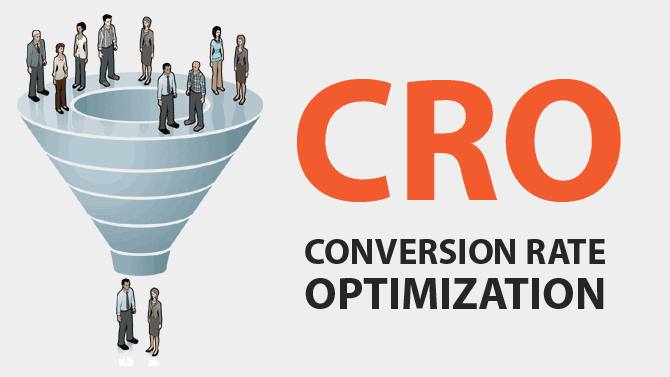
If thousands of visitors arrive and almost all leave without exploring further, there may be an opportunity to improve the journey. SEO brought them in. Now CRO needs to determine what happens next.
Stop asking which keyword gets the most traffic
Keyword research becomes much more useful when you stop asking: “Which keyword has the biggest search volume?” and start asking: “What would someone searching this phrase actually want?”
For service businesses, that shift can completely change an SEO strategy. You start building educational content around real customer problems. You create service pages around genuine commercial intent. You connect early-stage articles to later-stage pages. And you begin measuring whether organic visitors are actually moving through that journey.
That's the approach I've built into my SEO Workbook.
It takes you through keyword research, search intent, competitor analysis, website structure, pillar and cluster planning, internal linking and a practical content roadmap, so you're not simply collecting keywords and hoping some of them generate customers.
Because your SEO strategy doesn't need to attract everyone searching Google.
It needs to make your business easier to find for the people who are actually looking for what you do.