Is Your Website Structure Costing You Google Rankings and Leads? A Guide for Service Businesses

You have a homepage. An About page. A Services page. A Contact page.
And somewhere in the navigation there's a Blog containing 37 articles written over the past four years. Technically, you have everything a business website is supposed to have.
But there's a problem. None of it really connects.
Your Services page briefly mentions six different services. Your blog posts target random keywords you've discovered over the years. Some articles link to other articles. Others don't link anywhere. And your most commercially valuable services are buried several clicks away from the homepage. This isn't simply an SEO problem. It's also a customer journey problem.
For an Adelaide service business competing for local searches, website structure can influence both Google's understanding of your business and a potential customer's ability to find what they need. Before publishing another 20 SEO articles, it may be worth fixing the foundation they're being built on.
Why website structure matters beyond SEO
Website structure sounds technical. But the basic idea is simple:
Which pages exist, how they're organised and how they connect to one another.
Imagine walking into a supermarket where bread is next to shampoo, milk is beside gardening equipment and there are no signs above the aisles. Everything you need might technically be inside the building. Finding it would still be frustrating. Websites aren't particularly different.
A logical structure helps search engines understand the relationships between your pages. But it also helps a visitor answer three important questions: Where am I? Can this business solve my problem? Where should I go next?
That's why good site architecture shouldn't be designed exclusively for Google. It should make sense to humans too.
The common “one Services page” problem
This is something I see frequently with service-business websites. The navigation contains:
Home | About | Services | Blog | Contact
Under Services, the business lists everything it does. Imagine an Adelaide accounting firm offering:
bookkeeping
business accounting
tax planning
payroll
SMSF accounting
business advisory
All six services appear on one page. That might look tidy. From an SEO perspective, however, it creates a problem.
What exactly should that page rank for? “Accountant Adelaide”? “Bookkeeping Adelaide”? “SMSF accountant Adelaide”? “Business advisory Adelaide”? You're asking one page to communicate relevance across several different search intentions. There's a customer-experience problem too.
Someone specifically searching for an SMSF accountant doesn't necessarily want to read through a general overview of everything the firm offers. They want to know:
Do you provide the service I need?
Do you understand my situation?
Why should I choose you?
What happens if I contact you?
A dedicated service page gives you room to answer those questions properly.
Build your website around services, not keywords
This doesn't mean creating a separate page for every keyword variation you discover. That's the opposite extreme. Your structure should reflect the actual services and topics your business needs to communicate. A simple model might look like this:
Homepage
Your homepage establishes the broader picture.
It should clearly communicate:
what you do,
who you help,
where you operate,
your core services,
why customers should trust you,
and the next step.
It can then guide visitors towards individual service areas.
Core service pages
Each commercially important service should usually have enough dedicated content to answer the questions someone considering that service would reasonably have.
For example:
/services/bookkeeping/
/services/business-accounting/
/services/tax-planning/
/services/business-advisory/
Now each page has a clear purpose.
Keyword research can help you understand how people describe those services, but the website architecture isn't being created purely around keywords. It's being created around customer needs.
Supporting content
This is where your educational SEO content becomes much more strategic.
Instead of asking:
“What should we write about this week?”
ask:
“What does someone need to understand before choosing this service?”
If business advisory is an important service, supporting articles might answer questions around:
cash-flow forecasting,
profit versus revenue,
business budgeting,
financial KPIs,
or preparing for business growth.
Those articles now have a reason to exist. They support a commercially important topic.
Where pillar and cluster content fits
You've probably heard the terms pillar page and topic cluster. They can sound more complicated than they are. Think of a pillar as a central topic and clusters as related questions surrounding it.
For example:
Pillar: Local SEO
Supporting content could include:
how to optimise a Google Business Profile
how local citations work
whether reviews affect local visibility
local keyword research
local landing pages
tracking local SEO leads

Those articles shouldn't live as six unrelated blog posts. They should connect. Where appropriate, supporting articles link towards the main topic. The main page can also guide readers towards useful supporting resources. You're creating a network of related information rather than a collection of isolated URLs.
Stop creating orphan blog posts
This leads to one of the simplest pieces of SEO housekeeping you can do. Open your blog and choose an article. Now ask:
Where can someone go from here?
Many business blogs effectively end with:
Thanks for reading.
That's a missed opportunity.
This is where internal linking becomes both an SEO tactic and a conversion tactic.
Match internal links to the customer journey
Internal linking shouldn't mean inserting twenty links into every article because an SEO tool recommended it. Links should help people move logically through information.
For example:
Informational article
“How Often Should Commercial Air Conditioning Be Serviced?”
↓
Commercial page
“Commercial Air Conditioning Maintenance”
↓
Conversion
“Request a Maintenance Quote”
That's a customer journey.
Now imagine the article instead links to “5 Office Interior Design Trends” because both articles happen to mention offices. Technically, you've added an internal link. Commercially, it makes little sense. Good internal linking considers what the visitor is likely to need next.
A simple website structure for an Adelaide service business
Let's imagine you operate a physiotherapy clinic. A simplified architecture could look like:
Homepage
↓
Services
→ Sports Physiotherapy→ Back Pain Treatment→ Post-Surgery Rehabilitation→ Women's Health Physiotherapy
↓
Supporting content
Sports Physiotherapy→ Running injury guide→ When to see a physio after an injury→ Recovery versus training load
Back Pain Treatment→ Common causes of lower back pain→ When back pain requires assessment→ Desk setup and back pain
↓
Conversion actions
→ Book an appointment→ Call the clinic
Notice what's happening. The blog isn't sitting separately from the business. It's supporting it.
SEO content brings people into relevant parts of the website. Internal links help them explore their problem. Service pages explain the solution. Calls-to-action give them somewhere to go. That's a much more useful system than simply trying to generate traffic.
Better structure can improve traffic and conversions
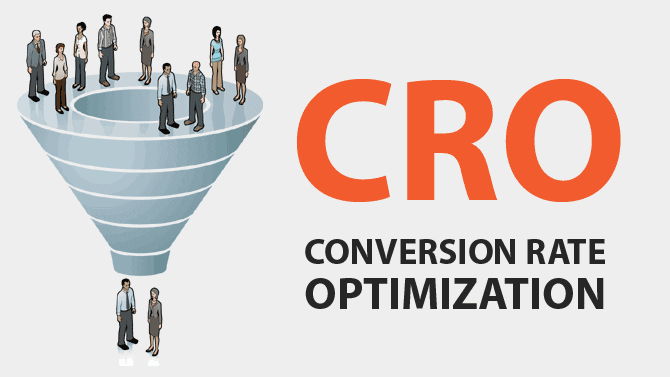
This is why I don't like separating SEO from conversion rate optimisation too aggressively. Consider what happens when your website structure improves. Google gets clearer signals about your major topics. Your important pages receive more relevant internal links. Visitors can navigate between related information. Educational content leads naturally towards services. Service pages address specific needs rather than trying to cover everything. Calls-to-action appear at logical points in the journey.
That's not just SEO optimisation. That's a better website.
And ultimately, that's what you're trying to build.
Turn your website into a connected SEO system
If your SEO strategy currently looks like:
find keyword → write blog → publish → repeat,
you may not need more content yet.
You may need a better structure for the content you already have. My SEO Workbook is designed to help service-business owners work through this strategically, from keyword and competitor research to search intent, website structure, pillar and cluster planning, internal linking and a practical 90-day content plan.
Because good SEO isn't about collecting as many pages as possible. It's about creating a connected system where search visibility, useful content and conversion paths all support the same business goal.

