Your SEO Traffic Is Growing — But Is It Actually Generating Leads? A GA4 Guide for Service Businesses

Your monthly SEO report arrives.
Organic traffic: up 32%.
Google impressions: up 41%.
Several keywords have moved onto page one. It looks like SEO is working. But then you look at the number of enquiries coming through the business. Nothing has really changed.
This is where many service businesses run into a measurement problem. They're tracking whether their SEO is generating traffic, but not whether that traffic is generating commercial outcomes. For a Brisbane accountant, builder, allied health clinic, law firm, consultant or other service provider, another 2,000 website visitors aren't particularly valuable if those visitors don't eventually become enquiries.
The solution isn't to stop measuring traffic. It's to connect traffic with what happens after the click. And that's where Google Analytics 4 becomes much more useful.

The SEO report that can give you false confidence
Imagine your organic traffic looks like this:
Month | Organic visitors | Enquiries |
May | 1,500 | 32 |
June | 1,850 | 33 |
July | 2,300 | 31 |
August | 2,700 | 32 |
If you only looked at traffic, this would appear to be a successful SEO campaign. Organic visitors increased by 80%. But enquiries remained almost completely flat. That's not necessarily evidence that SEO has failed. It is evidence that you need to investigate further.
Maybe the new traffic is informational.
Maybe you're ranking for the wrong searches.
Maybe visitors are landing on blog articles with no pathway towards your services.
Or perhaps the right people are arriving, but your service pages aren't convincing them to take the next step.
GA4 can help you distinguish between those problems.
Traffic is not the same as business growth
SEO metrics broadly sit at different stages of the customer journey. At the visibility level, you might measure:
Impressions → Rankings → Clicks
Once someone reaches the website, however, another set of behaviours becomes important:
Landing page → Engagement → Service exploration → Conversion
And finally, the business cares about:
Lead → Qualified lead → Customer → Revenue
A common SEO reporting problem is stopping somewhere around clicks and traffic. That's like measuring how many people walked into a shop without checking whether anyone bought something. For service businesses, your measurement needs to go further.
Step 1: Decide what an SEO conversion actually means
Before configuring anything in GA4, define what a valuable action looks like for your business.
For an e-commerce website, that's relatively straightforward: someone purchases something.
Service businesses tend to have more complicated journeys.
A potential customer might:
submit an enquiry form
request a quote
book a consultation
click a phone number
click an email address
schedule an appointment
download an important resource
Not all of these actions are equally valuable. Someone clicking your phone number doesn't necessarily mean they called. Someone downloading a guide isn't necessarily ready to purchase. That's okay. The objective is to identify actions that show increasing commercial intent.
You can then start distinguishing between a visitor who simply reads a page and one who begins moving towards becoming a customer.
Step 2: Make sure GA4 is tracking those actions
This sounds obvious, but it's worth checking. A business can spend thousands of dollars on SEO while having incomplete analytics installed on its website. GA4 may be collecting page views perfectly while the actions that actually matter aren't configured properly.
For example, suppose your main objective is generating consultation requests.
A visitor:
lands on a service page,
reads about your service,
clicks Book a Consultation,
completes the form,
and reaches a confirmation page.
If you're only measuring the page view at the beginning of that journey, you're missing the most valuable information. You want your analytics setup to recognise the important event at the end as well. Once meaningful events are being captured correctly, you can start asking much better questions.
Step 3: Look at landing pages, not just organic traffic
Here's where the analysis becomes useful. Instead of asking:
“How much organic traffic did we get?”
ask:
“Which pages brought organic visitors into our website and what happened afterwards?”
Imagine two pages.
Page A
How Much Does a Bathroom Renovation Cost in Brisbane?
Organic sessions: 1,800
Enquiries: 35
Page B
10 Bathroom Design Trends for 2026
Organic sessions: 4,500
Enquiries: 7
Page B looks far more impressive in a traffic report. But Page A appears considerably more valuable commercially. Why? Search intent.
Someone researching bathroom design trends could be looking for inspiration. Someone researching the cost of a bathroom renovation in Brisbane may be much closer to choosing a provider. Traffic volume alone hides that distinction.
Step 4: Find your high-traffic, low-conversion pages
One of the most useful exercises you can perform is identifying pages with high organic traffic + low conversion activity.
These pages represent potential opportunities. You're already doing the difficult part. Google is sending people to them. Now you need to determine why those visitors aren't progressing.
Create a simple table:
Landing page | Organic sessions | Conversions | Conversion rate |
Page A | 2,100 | 42 | 2.0% |
Page B | 1,900 | 8 | 0.4% |
Page C | 850 | 34 | 4.0% |
Page B deserves attention.
But don't immediately add a giant red GET A QUOTE button. First understand why the page behaves differently.
Step 5: Investigate why visitors aren't converting
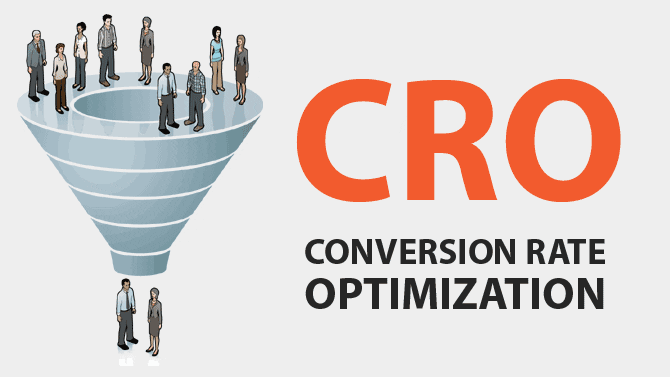
Analytics tells you what is happening. But it doesn't automatically tell you why. That's where conversion rate optimisation begins.
Several problems that commonly appear.
Search intent mismatch
Weak above-the-fold messaging
Missing trust signals
Poor calls-to-action
Mobile friction
Step 6: Don't ignore assisted conversions
There's another reason SEO can be undervalued. Customers don't always convert during their first visit.
Someone might discover your business through Google, read an article, leave, return several days later, read your service page, leave again, and then finally search your business name to submit an enquiry.
If you only look at the final interaction, you may miss the role SEO played earlier. This is particularly important for higher-consideration services where customers research several providers before making contact. Instead of expecting every organic visit to generate an immediate enquiry, examine how SEO contributes throughout the journey. That gives you a much more realistic picture of its value.
Build a simple SEO measurement routine
You don't need a 40-page analytics report every month. For many small and medium service businesses, a much simpler routine is more useful.
Once a month, review:
1. Organic traffic
Is visibility increasing or declining?
2. Organic landing pages
Where are visitors entering?
3. Search intent
What types of searches are generating those visits?
4. Conversion actions
Are organic visitors enquiring, calling, booking or taking other meaningful actions?
5. Conversion rate by landing page
Which pages attract traffic but struggle to move visitors forward?
6. High-performing pages
Which pages generate disproportionately strong commercial results?
7. Opportunities
What should you actually change next month?
That last question matters most.
Analytics isn't valuable because you collected the data. It's valuable because the data helped you make a better decision.
Turn your SEO data into an action plan
If your organic traffic is growing but your enquiries aren't, publishing more content isn't automatically the answer.
You may need to improve an existing service page.
You may need to change your keyword targeting.
You may need stronger internal links between your informational content and commercial pages.
You may need to simplify your enquiry process.
Or you may discover that GA4 hasn't been measuring your most important actions correctly in the first place.
This is why I don't think SEO should be treated as a race to generate the largest possible traffic number. The goal is to create a connected system between what people search, where they land, what they experience and what they do next.
My SEO Workbook is designed to help service-business owners work through that system step by step—from keyword and competitor research to website structure, pillar content, internal linking, content planning and conversion-focused improvements.
Instead of asking “How do I get more traffic?”, it helps you ask the more commercially useful question: “How do I turn the right search traffic into more opportunities for my business?”


Comments