Your Service Page Ranks on Google But Why Isn’t It Generating Enquiries?

You've done something many businesses are trying to achieve. One of your main service pages is ranking well on Google. You're getting impressions. People are clicking. Organic traffic is arriving. But there's one problem. Hardly anyone is enquiring.
At this point, it's tempting to assume you need to rank higher. If you're currently position six, perhaps position three will solve it. If you're position three, maybe you need position one. Sometimes better rankings absolutely can produce more opportunities. But there's another possibility worth investigating first: The SEO is getting people onto the page, but the page isn't doing enough once they arrive.
For a Perth service business competing for valuable local searches, this distinction matters. You've already done the difficult work of earning visibility. Before spending more money generating additional traffic, it makes sense to understand what your existing visitors experience.
Ranking is only half the job
Think about the journey from your customer's perspective. They have a problem. They search Google. They see several results. They choose yours. At this point, SEO has done its first job. But the visitor still hasn't chosen your business. They've only chosen your search result. Now a second evaluation begins. Within seconds, they're trying to determine:
Am I in the right place?
Does this business actually provide what I need?
Do they work with people like me?
Can I trust them?
What will happen if I contact them?
Is taking the next step worth it?
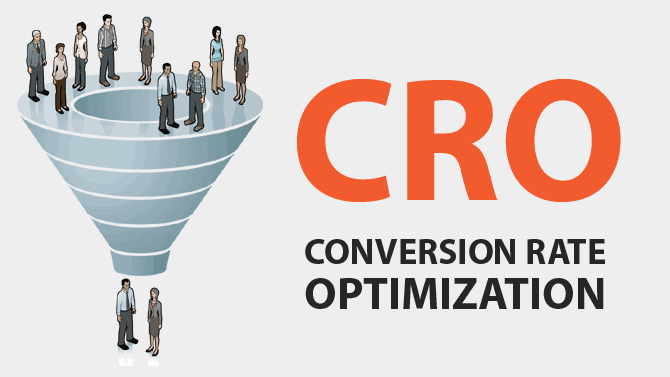
That's where conversion rate optimisation becomes inseparable from SEO. Here are eight areas I'd investigate before deciding the solution is simply “more traffic”.
1. Check whether the page matches the searcher's intent
A page can rank for a keyword without perfectly satisfying the person behind that search. Imagine you operate a commercial cleaning company. Your page starts ranking for: “office cleaning Perth”. Great. But the page itself talks broadly about: residential cleaning, end-of-lease cleaning, commercial cleaning, carpet cleaning, and office cleaning.
The searcher wasn't asking about five services. They were looking for one. Compare that with a dedicated page for Commercial office cleaning for Perth businesses followed by information about the types of workplaces serviced, what's included, service frequency, your process, relevant experience, and how to request a quote.
The second page creates much stronger continuity between the search and the landing experience. That's important. Your customer shouldn't have to work out whether they've found the right page.
2. Look at the first screen before anything else
Open one of your most important service pages on your phone. Don't scroll. Now pretend you've never heard of the business. What can you understand? Within that first screen, can you identify what the company does, who the service is for, where it's offered, and what to do next?
Many websites sacrifice clarity for cleverness. You see headlines such as “Transforming Possibilities”, “Solutions Designed Around You”, “Experience the Difference”, etc.
They sound polished. But what does the company actually do?
Compare that with "Bookkeeping for Perth Small Businesses", "Get clear, reliable monthly bookkeeping without adding another employee to your team", "Book a discovery call".
It's not trying to win a copywriting award. It's trying to remove uncertainty. For service pages, clarity usually deserves priority.
3. Replace generic copy with customer problems
Have a scroll down your page. How much of the copy is about you?
“We are passionate...”
“We pride ourselves...”
“We provide innovative solutions...”
“Our experienced team...”
There's nothing inherently wrong with talking about your business. But potential customers usually arrive because they're trying to solve their problem, not learn your company biography. Suppose you're an accountant targeting growing businesses. Instead of starting with:
“Our experienced accountants provide comprehensive financial solutions tailored to your unique requirements.”
you might want to address situations customers recognise like "Revenue is growing but you still don't have a clear picture of profitability?", "Cash flow regularly catches you by surprise?", "You've outgrown basic bookkeeping but aren't ready for a full-time finance team?", etc ...
Now the visitor can recognise themselves in the page.That's an important conversion principle: Relevance creates attention.
4. Give visitors enough reason to trust you
Service businesses often sell something customers can't properly evaluate before purchasing. You can't inspect legal advice before engaging the lawyer. You don't know how effective a physiotherapist will be before beginning treatment. You can't fully evaluate a builder's project management before construction begins.
That creates perceived risk. Your website needs to reduce it. Useful trust signals might include:
customer testimonials
reviews
professional registrations
case studies
examples of previous work
recognisable clients
guarantees, where appropriate
a clear explanation of your process
The important part is where these appear. If every trust signal is hidden on your About page, many visitors will never see them. Place reassurance near the moments where someone is deciding whether to move forward.
5. Make your location genuinely relevant
For local service businesses, location matters. But local SEO doesn't mean repeatedly inserting Perth into every paragraph. A page reading:
“Our Perth plumbers provide Perth plumbing services to Perth homeowners looking for a Perth plumber...”
isn't useful.
Location should provide context. Your location information should help someone answer “Does this business actually serve me?”. That's much more useful than simply increasing city-name frequency.
6. Remove unnecessary conversion friction
Sometimes a visitor is convinced. Then the website gets in the way.
Consider an enquiry form asking for:
First name
Surname
Phone
Company
Job title
Address
Suburb
Service
Budget
How did you hear about us?
Do you genuinely need all of that before having a conversation?
Every field creates a small amount of friction. For some high-value services, detailed qualification may make sense. For others, it can discourage perfectly good prospects. Look at your conversion process from the customer's perspective. How much commitment are you asking for? How long does the form appear? Do they know what happens after submitting it? Do they know when you'll respond? Could someone call instead? Can mobile users complete it comfortably?
Reducing friction doesn't mean removing qualification. It means making sure every obstacle has a reason to exist.
7. Connect informational content to your service page
Your service page isn't necessarily where the customer first discovers you. They might enter through an article.
Suppose a Perth building inspector publishes:
“What to Check Before Buying an Older Home”
The article performs well in search. Hundreds of potential buyers read it. At the bottom it says:
Thanks for reading. Check out our other blogs.
That's a wasted opportunity.
A reader who has just learned about hidden problems in older properties has a logical next question: How do I make sure the property I'm considering doesn't have these issues? That's where a contextual link towards a pre-purchase building inspection service becomes useful. Not because you're trying to force a sale. Because it genuinely represents the next step for someone who needs help. Good internal linking can support SEO. But it can also build a customer journey.
8. Use GA4 to diagnose rather than guess
Once you've checked the page manually, look at what visitors actually do. Google Analytics 4 can help you identify where the journey might be breaking. Don't just look at page views. Consider the pattern.
Traffic but very little engagement
People arrive and leave quickly without meaningful interaction. Possible questions:
Does the page match search intent?
Is the opening message clear?
Is the page slow or difficult to use?
Are visitors getting the answer they need immediately and leaving, or are they simply deciding the page isn't relevant?
Don't assume. Investigate.
Engagement but no CTA activity
Visitors spend time consuming the page but rarely progress towards contacting you. Now consider:
Is the offer clear?
Are trust signals strong enough?
Is the CTA visible?
Does the page explain what happens next?
Is there a logical reason to enquire?
CTA activity but no completed enquiries
This is particularly interesting. People appear interested enough to begin taking action but aren't finishing. Now inspect the conversion mechanism itself.
Is the form too long?
Is there a technical problem?
Does it work properly on mobile?
Are error messages clear?
Does the booking system create unnecessary steps?
You're narrowing the problem. That's much more useful than simply saying “The page doesn't convert.”
Build SEO and conversion into the same strategy
This is why I believe service businesses should stop thinking of SEO as simply “ranking on Google”. A commercially useful SEO strategy connects:
Search intent → Keyword → Search result → Landing page → User experience → Trust → CTA → Conversion → Measurement
If one part breaks, adding more traffic won't necessarily fix it. My SEO Workbook is designed around that bigger picture.
It guides you through keyword research, search intent, competitor analysis, website structure, pillar and cluster planning, internal linking and conversion-focused website reviews so you can identify where your SEO system is actually losing opportunities.
Because getting onto page one is an achievement. But getting the right person from Google onto your website and making it easy for them to take the next step is where SEO starts becoming commercially valuable.