Getting SEO Traffic but No Leads? 7 Reasons Your Melbourne Service Business Isn’t Converting

Your rankings are improving. Organic traffic is climbing.
Google Search Console shows more clicks. Everything looks like SEO is heading in the right direction.
Except for one fairly important number:
Enquiries aren’t increasing.
This is one of the most frustrating situations for a service-based business investing in SEO.
It can also lead to the wrong conclusion:
“We need more traffic.”
Maybe.
But as a Melbourne service business, if 500 visitors aren't producing enough enquiries, sending another 500 people through the same customer journey may simply make the problem bigger.
That is where SEO and conversion rate optimisation (CRO) need to start working together.
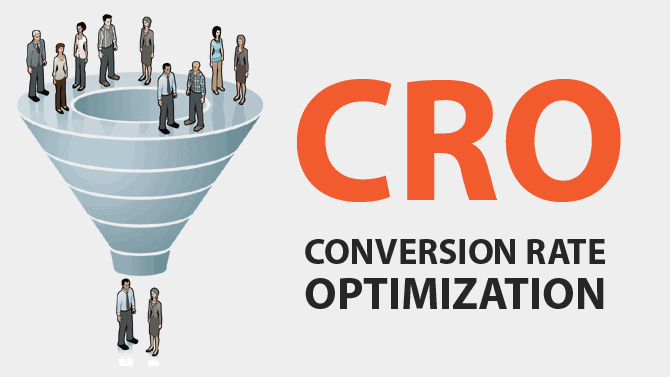
More traffic isn't always the answer
Imagine you run an accounting, legal, allied health, consulting, construction or any other service business in Melbourne. Your SEO work increases organic traffic from 500 visitors per month to 1,000. Sounds great.
But imagine your website generates five enquiries from those 1,000 visitors. Before investing heavily in generating another 1,000 visits, it makes sense to understand why 995 people didn't enquire.
Of course, not every visitor should become a lead. Some will be researching. Some aren't the right customer. Others aren't ready to buy. But those behaviours contain useful information. SEO gets someone through the door. Your website then needs to give the right person enough relevance, clarity and confidence to take another step.
Here are seven places that journey commonly breaks down.
1. You're attracting people who were never going to buy
One of the easiest SEO mistakes is focusing heavily on search volume without paying enough attention to search intent.
Consider two searches:
“What does a building inspector do?”
and
“pre purchase building inspection Melbourne”
Both could be relevant to a building inspection company. But they're unlikely to represent the same level of buying intent. The first person may simply want information. The second appears much closer to needing a service. This doesn't mean informational keywords are useless. They can play an important role in building awareness and authority.
The problem occurs when a business sees increasing organic traffic and assumes that increase should automatically translate into the same increase in leads. It won't if much of the new traffic sits at the top of the funnel.
What to check
Look beyond total organic sessions and review:
which landing pages organic visitors enter through
the search queries generating those visits
whether those pages target informational or commercial intent
which pages eventually contribute to enquiries
A smaller number of highly relevant visitors can be considerably more valuable than thousands of people who were never looking for your service.
2. Your page answers Google—but not your customer
SEO can sometimes become a checklist:
Keyword in the title?
Keyword in the H1?
Internal links?
Word count?
But your potential customer isn't checking any of those things. They're asking:
“Can this business solve my problem?”
And usually, they're trying to answer that question quickly. A service page can be technically optimised for a keyword while still doing a poor job of communicating its value. Look at the top section of one of your important service pages. Without scrolling, can a visitor understand:
What do you do?
Who is it for?
What problem do you solve?
Where do you provide it?
What should they do next?
If the answer isn't obvious, SEO may be doing its job while the page itself is losing the lead.

3. Your website makes the next step too difficult
Sometimes there isn't a dramatic CRO problem. There is simply friction. Your visitor wants to contact you, but:
the phone number is difficult to find,
the enquiry form asks for too many pieces of information,
the call-to-action button isn't linked properly
or they need to navigate through several pages before understanding what happens next.
Every unnecessary decision creates another opportunity to leave. For most service businesses, your primary call-to-action should be clear. You don't necessarily need more buttons. You need a clearer path.
4. Your service pages are too generic
Imagine searching for a specific service and landing on a page that spends most of its time telling you:
“We pride ourselves on delivering innovative solutions tailored to our clients' unique needs.”
It sounds professional. It also tells the customer very little.
Generic marketing language forces visitors to work harder to determine whether a business actually understands their problem. Strong service pages should address the questions potential customers are already thinking about. For example:
What exactly is included?
Who is this service suitable for?
What problems does it solve?
What results can I expect?
The closer your content matches the customer's actual decision-making process, the easier it becomes for them to move forward.
5. Your website structure is working against you
Website structure isn't just a technical SEO consideration. It's also part of the customer experience. Suppose you provide five different services but squeeze all of them onto one enormous Services page.
Google has less clarity around which page should rank for each topic. Your visitor also has to search through the page for the service relevant to them. A clearer structure might look something like:
Homepage
→ Service category
→ Individual service pages
→ Supporting educational content
That supporting content can then form topic clusters around your core services.
For example, an accountant might have a core page targeting small business accounting, supported by articles answering related questions around BAS, bookkeeping, business structures and tax planning. Those articles shouldn't exist as isolated pieces of content.
Where relevant, they should guide readers towards the appropriate service page.
That's the difference between simply publishing blogs and building an SEO ecosystem.
6. You're measuring traffic instead of meaningful actions
Google Analytics 4 can tell you much more than how many people visited your website.
Yet many businesses still judge SEO primarily through: traffic, rankings and clicks.
Those numbers matter.
But they don't tell you whether SEO is contributing to the business.
Your GA4 setup should help you understand actions that indicate commercial intent.
Depending on your website, these might include:
enquiry form submissions
phone-number clicks
booking completions
quote requests
email clicks
important CTA interactions
Then start comparing behaviour between landing pages. You may discover that one page receives 3,000 organic visits and generates very few meaningful actions, while another receives only 400 visits but consistently contributes to enquiries. Which page deserves more attention?
Suddenly, your SEO decisions become much more commercially useful.
7. You're treating SEO and CRO as separate jobs
This is perhaps the biggest issue.
SEO is often treated as:
Get people onto the website.
CRO is treated as:
Make the website convert.
But your customer doesn't experience them separately.
→ They perform a Google search → They see your result → They click → They scan your page → They decide whether you're relevant → They look for reassurance → They decide whether taking the next step feels worthwhile.
That's one journey.
Your keyword targeting influences who enters that journey.
Your content influences whether they believe they've found the right solution.
Your website structure influences whether they can find what they need.
Your user experience influences whether they stay.
Your CTA influences whether they act.
And your analytics should tell you where that journey is breaking.
SEO shouldn't finish when somebody clicks your Google result. That's where the most commercially important part begins.
Build an SEO system designed for more than rankings
SEO can become overwhelming very quickly. The problem isn't usually a lack of SEO information. There's more free SEO advice online than most business owners could ever consume.The difficult part is turning all that information into a clear plan for your own website.
That's why I created my SEO Workbook for service-based businesses.

Rather than giving you another book of SEO theory, it walks you through the practical work: understanding search intent, researching keywords, finding your real competitors, planning pillar and cluster content, improving your site structure, creating a 90-day content plan and using real website data to improve your pages.
Because the goal shouldn't simply be to get more people from Google.
It should be to build a website that attracts the right people—and gives them a reason to become customers.


Comments